
If Kyoto has one image that ends up on every travel mood board, I am quite sure you have seen this one, the Arashiyama bamboo forest with the long pathway through tall leafy bamboo, and lots and I mean a lot of bamboo trees.
This was one of my travel bucketlist spots, and I spent five days in Kyoto and gave one full morning, wait no it was probably just more than half a day to Arashiyama.
For me, the bamboo forest was quite a surreal moment, I don’t come across rows of bamboos generally in my life, and when I came here, it was bright and early and fortunately not a lot of people which was great. But after a short while as I left, I was thinking whether this bamboo forest actually worth it?
I’ve put together this guide to tell you if the bamboo forest is worth visiting, what to actually expect at Arashiyama and also the monkey park which is in the area, and other things to do in Arashiyama like the Monkey Park Iwatayama. I also added some tour and experiences recommendations for your consideration throughout this article.
Just a heads up! This post may contain affiliate links, meaning I get a commission if you decide to purchase something through the links, at no additional cost to you. Your support helps me continue provide the best information to help you with your travels. Thank you!
Here are my top picks Hotels in Kyoto if you plan to stay:
⭐ The Thousand Kyoto : modern, peaceful and right next to Kyoto Station. Perfect if you’re coming in by train.
⭐ Gion Yoshi-Ima Ryokan : a traditional tatami-room stay right in Gion for the full Japanese experience, stunning rooms and good location as well.
⭐ Candeo Hotels Kyoto Karasuma Rokkaku : stylish, clean and central without the huge price tag, plus great decor and lovely rooms.
Tip: Book early. Kyoto’s tourism has bounced back strong in 2025 and prices rise closer to travel dates.
Click here to search for Hotel availabilites in Kyoto
If you are looking for experiences and things to do in Kyoto, here are some suggestions:
If you are looking for a fun things to do in Kyoto, you can get this fun Kyoto Samurai Experience or train like a samurai with this Samurai Training with Modern day Musashi in Kyoto
and this is so good with kids too Ramen Cooking Class at Ramen Factory in Kyoto
or this amazing experience KYOTO Tea Ceremony with kimono near by Imamiya Jinjya Shrine
The sites I use for booking experiences and Tours: Getyourguide | Viator | Klook
🗺️ Insurance: Protect yourself on your trip with Travel Medical Insurance.
📱 Connect: Always stay connected, and do so seamlessly, with a Japan eSim : I have used Saily for my travels.
🚗 Traveling around Japan? Find Affordable Car Rentals here!
My experience visiting Arashiyama Bamboo Forest
I visited the Arashiyama bamboo forest bright and early, I was told the earlier you get there, the quieter it will be. This is very true!
Arriving before 9am helps, we took the train and there are so many signs leading us to the bamboo forest, and passed by a few stalls selling food, so of course we had to grab some.
There are few groves of bamboo but of course theres only one main one, but feel free to explore them all.
It was everything I thought it will be, so peaceful and quiet and the sounds the bamboo made when the winds passes by. We felt free to take videos and pictures for the memories of course, and this website.
From start to finish, with the casual wandering around, was no longer than 20 minutes, you can tell when the buses are starting to arrive, the sheer number of people coming up. Though I have to say if you want great pictures, take it by the entrances (both of them).
For me, I enjoyed the bamboo forest, it was nothing like I had experienced before, granted as a city girl, I have rarely come across a lot of bamboo, but half an hour here or so is more than enough. While in the area, it was great to explore the rest of the town and of course the monkey park as well, and the other temples.
For me, the bamboo forest is a part of the whole experience of Arashiyama, I wouldn’t go specifically for it but to mix it with the other attractions would be better.
If you like to come here with a guide, there’s also a guided tour to Arashiyama with Bamboo forest and Monkey Park
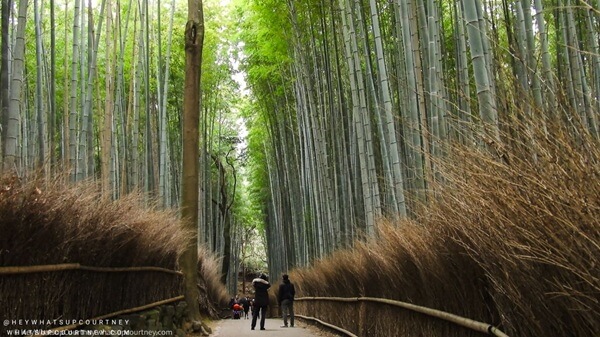
How to get to Arashiyama Bamboo Forest from Kyoto
From Kyoto Station I took the JR Sagano Line to Saga-Arashiyama Station. The journey takes about fifteen minutes and costs 240 yen. The JR Pass covers it. From the station it is a flat ten-minute walk to the bamboo grove, past souvenir shops that are still pulling their shutters up as I pass.
There is also the Randen tram line from Shijo-Omiya, which is slower and slightly more expensive but drops you right at the edge of the Tenryu-ji gardens, about two minutes from the grove entrance. On the way back, a few of us split an Uber, which made good financial sense and saved the walk.
| Getting there JR Sagano Line: Kyoto Station to Saga-Arashiyama, 15 minutes, 240 yen. Covered by JR Pass. Randen tram: from Shijo-Omiya to Randen Arashiyama Station. Drops you closest to the grove. Uber or taxi: reasonable when splitting with a group. From JR station: flat 10-minute walk to the bamboo grove. |
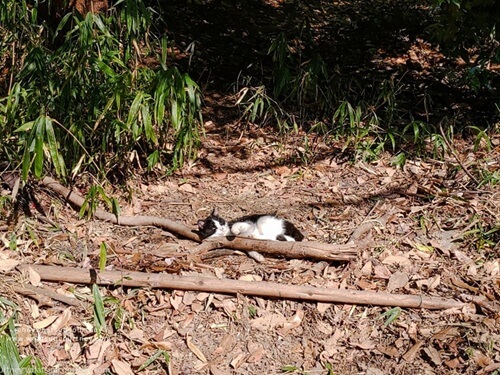
The Arashiyama Bamboo Forest
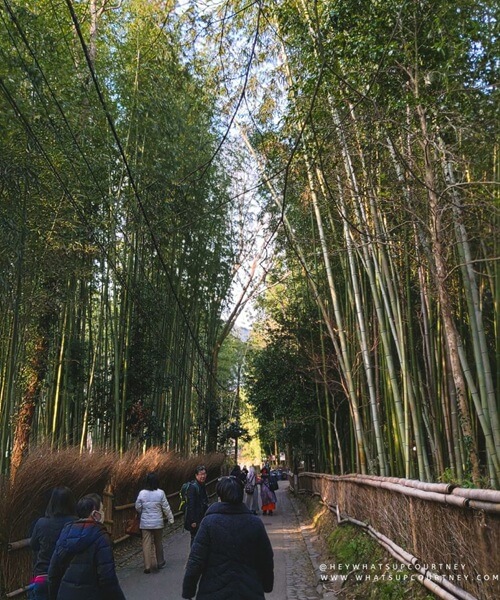
I walked into the main bamboo grove just before 9am in the morning and the path is almost empty. This was exactly like how it is in the videos and pictures.
The sound of the leaves rustling in the wind is the thing I did not expect. When the wind moves through bamboo this dense it makes a specific hollow clicking and rustling, and later on I found out that the Japanese Ministry of Environment has listed this as one of the country’s 100 Soundscapes.
We walked the full length in about 20 minutes or so at a comfortable pace. Well maybe 30 minutes, we did stop to take pictures and videos while there weren’t too many people.
The path is around 400 metres from the Tenryu-ji north gate to the far end near Okochi Sanso Villa. Both sides are fenced with woven bamboo panels, put up to stop people damaging the stalks, and the fencing means the forest feels slightly more corridor-like than the photographs suggest.
By the time I reach the far end and turn back, a few other visitors have arrived. By nearly 10am the path behind me is noticeably busier. By ten, from what I see later, it was packed.
The bamboo grove is free to enter and open around the clock, though of course there is no light after dark so a night visit is not worth it unless you just fancy it I guess.
After the bamboo forest, we walked through and continue into the neighbourhood. The area around Tenryu-ji Temple connects directly to the grove and the temple garden (about 500 yen) is worth the time. The bamboo is one part of a wider district that rewards wandering.
Things to do near Arashiyama Bamboo Forest
Nonomiya Shrine: Inside the Grove
Partway along the bamboo path, set back slightly from the main route, is Nonomiya Shrine. It is small and painted vermilion and dedicated to the deities of marriage and fertility. Couples come here specifically to pray, and there are hundreds of small wooden ema prayer plaques hung around the structure with wishes written on them.
I stop for a few minutes and paid my respects. The shrine feels ancient in a way that the bamboo path, for all its atmosphere, does not. It has been here since the Heian period, over a thousand years ago, when imperial princesses came to purify themselves before heading to the Ise Grand Shrine. The small black torii gate at its entrance is made of unbarked wood in the oldest surviving shrine style.
| Nonomiya Shrine Location: partway along the bamboo grove path, set back from the main route. Free entry. No set hours. Dedicated to Susanoo-no-Mikoto and Nonomiya Okaminomae-no-Kami. Prayers for love, marriage, and fertility. The black torii gate is made in the unbarked wood style (kuroki torii), one of the oldest forms in Japan. |
Tenryu-ji Temple and Garden
At the southern end of the bamboo grove, connected directly via the north gate, is Tenryu-ji. It is a UNESCO World Heritage site and one of Kyoto’s five great Zen temples, founded in 1339 by the shogun Ashikaga Takauji. The garden was designed by the Zen monk Muso Soseki and has remained essentially unchanged for nearly seven centuries.
I walk through the north gate coming back from the grove and find myself in the garden with almost no one else here. The central pond reflects the Arashiyama mountains behind it in a compositional trick called shakkei, borrowed scenery, where the landscape beyond the garden walls becomes part of the design. In autumn the maple trees around the pond turn red. In spring cherry blossoms appear at the edges. Today, in the morning light, the reflections are sharp enough that the mountain appears to be floating.
The garden entrance is 500 yen. Worth it. The buildings are an extra 300 yen and include a painted Cloud Dragon ceiling in the Hatto hall. If you have time, add it.
| Tenryu-ji Temple Open: 8:30am to 5pm (last entry 4:50pm). Opens at 7:30am during autumn foliage season. Garden admission: 500 yen. Temple buildings: additional 300 yen. UNESCO World Heritage Site. |
You must continue North: Where the Tourists Stop Going
Most visitors reach the far end of the bamboo path, turn around, and head back toward the station and the main tourist strip. I walk north instead.
Within ten minutes the crowds are gone. The path leads through the Sagano neighbourhood, past low wooden houses and small gardens and the occasional cat watching from a wall. The Saga-Toriimoto Preserved Street, a stretch of traditional townscape with thatched roofs and tiled buildings, runs through here and it is one of the few surviving streets of this type in all of Kyoto.
Jojakko-ji Temple
About fifteen minutes north of the bamboo grove, up the slope of Mt Ogura, you can find Jojakko-ji temple. I almost miss the entrance.
The temple was founded in 1596 and the grounds are covered in deep green moss under over two hundred maple trees. A two-storey pagoda stands behind the main hall, 12 metres tall, and above it there is a wooden viewing platform with a panoramic view over Arashiyama and the whole of Kyoto spread out below. I sit up here for a while, there were a few people that came, mainly the locals and some tourists like me.
I read later on that in autumn the maple leaves fall onto the green moss and the pagoda and it becomes one of the most photographed spots in the area. So if you are here during Autumn season, even more of a reason to have a visit. It costs 400 yen to enter.
| Jojakko-ji Temple Open: 9am to 5pm daily (last entry 4:30pm). Admission: 400 yen. 15-minute walk north from the bamboo grove. Follow the path past Nison-in signs. Best season: mid-November for autumn maple colour. Worth visiting year-round. Allow: 30 to 45 minutes. |
Gioji Temple
A few minutes further north is Gioji, a Buddhist nunnery named after Gio, a dancer from the Heike period who retreated here after her relationship with the clan leader Taira no Kiyomori ended. The story gives the place an unusual emotional weight for somewhere so small.
The entire ground is covered in thick moss. Maple trees and bamboo grow above it. The main hall has a thatched roof and a round window that frames the garden the way a lens would. The moss after overnight rain is a shade of green so bright it looks artificially lit.
| Gioji Temple Open: 9am to 5pm (last entry 4:30pm). Admission: 300 yen adults, 100 yen students. 5-minute walk from Jojakko-ji. Best after rain: the moss is vivid green. Also beautiful in autumn. Allow: 20 to 30 minutes. |
Adashino Nenbutsuji Temple
At the far end of the northern walk is Adashino Nenbutsuji, and it is the one I think about most afterwards.
The temple grounds contain over 800 stone statues, placed here over centuries for the souls of travellers who died on the roads and were left unburied. The monk Kukai placed the first stones here in the 9th century. The statues have been here in various forms since, worn down by weather, covered in moss, scattered across the grounds in no particular arrangement. At the back of the temple a short path runs through a small private bamboo grove, dense and shadowed, almost completely silent.
This is the bamboo forest alternative that guides mention but rarely describe properly. It is smaller than the main Arashiyama grove and denser and there is nobody in it. I stand in it for several minutes. It is more atmospheric than anything I experienced that morning on the main path.
One important note: from April 2026 the admission increases to 1,000 yen, up from the previous 500 yen. Also, the temple is closed on Wednesdays and Saturdays. Check before you go.
| Adashino Nenbutsuji: check before visiting Open: 9am to 4:30pm (last entry 4:15pm). Closed Wednesdays and Saturdays. Admission: 1,000 yen from April 2026. Verify at nenbutsuji.com. 40-minute walk from the bamboo grove, or 20 minutes from Jojakko-ji. The private bamboo grove at the back: small, dense, uncrowded, and genuinely atmospheric. |
Where to Eat and Drink in Arashiyama
The main tourist strip along the river near Togetsukyo Bridge has restaurants and cafes at every price point. There are better options if you know where to look.
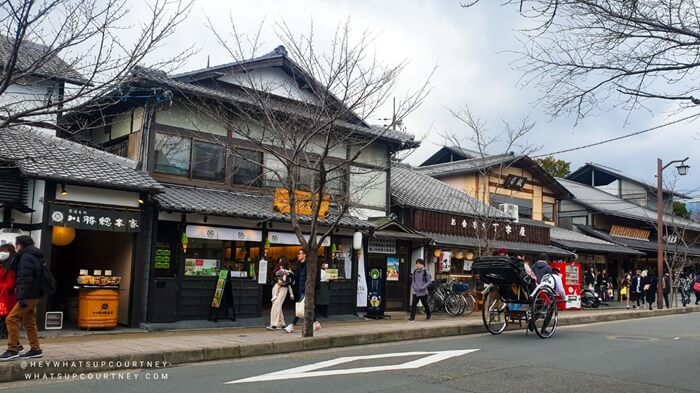
On the way to the bamboo grove, the approach stalls sell matcha soft serve, warabi mochi (soft bracken starch squares dusted in kinako), and skewered foods. These are part of the experience.
There are so many cute shops and bakeries as well.
Arabica Kyoto has a branch right at the corner of the Togetsukyo Bridge, open from 9am. It is a good coffee after the morning walk. The queue moves quickly.
For a sit-down lunch, the area around the bridge has tofu restaurants serving yudofu, tofu simmered at the table in kombu broth. It is the Arashiyama speciality and it is the right thing to eat here. Nakaichi, just south of the bridge, is reasonably priced and does the job well.
Shigetsu inside Tenryu-ji is the famous option: a multi-course Zen Buddhist vegetarian meal in a temple garden. It is 3,000 to 5,500 yen and worth it for a special occasion. Book ahead.
| Eating in Arashiyama Matcha soft serve and warabi mochi: on the approach stalls. 300 to 500 yen. Eat while walking. % Arabica Arashiyama: corner of Togetsukyo Bridge. Opens 9am. Good coffee. Nakaichi: south of the bridge. Yudofu tofu sets and seasonal fish. Reasonable prices. Shigetsu (inside Tenryu-ji): Zen Buddhist vegetarian multi-course. 3,000 to 5,500 yen. Book ahead. |
Togetsukyo Bridge and the Riverside
After coming down from the monkey park, the riverside area around the Togetsukyo Bridge is worth some time. The bridge is about 155 metres long and sits against forested mountains that look genuinely like a classical Japanese painting, especially before the main tourist crowd arrives.
It dates to 836 originally, though what you are looking at is a 1930s reconstruction. The view from downstream is actually better than the view from the bridge itself, which gets busy quickly.
Along the river there are souvenir shops and cafes. Arabica Kyoto has a branch right at the corner of the bridge and if you need coffee after the monkey park climb it is a decent stop. There are also boat rentals on the Hozu River if you want something more leisurely.
North of the bridge the area quietens down. Worth walking a little upstream just to notice the shift. The main Arashiyama shopping street has a lot of the same tourist things. You do not need to spend long there.
The Monkey Park Iwatayama
On the south side of the Togetsukyo Bridge, about fifteen to 25 minutes from the bamboo grove on foot, is the entrance to the Arashiyama Monkey Park. If you have half a day and reasonable energy left after the grove and the northern temples, it is worth doing.
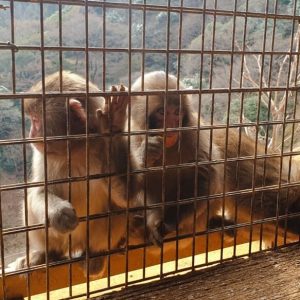
The short version: it is a real climb up, not the gentle walk described on the signs (for me anyway). At the top, 120 wild Japanese macaques roam freely around you. The feeding hut has you inside the mesh enclosure and the monkeys pressing against the outside of it. The view over Kyoto from the summit at 160 metres is one of the best in the city. I watched one of them steal a tourist’s hat and spend ten minutes examining it while the tourist stood completely still and waited.
I have written a full separate post on the Arashiyama monkey park with everything you need: the hike, the rules, what to expect at the summit, and what to do on the south side of the river before you cross back.
| Monkey park quick facts Entrance: south side of Togetsukyo Bridge, 15-minute walk from the bamboo grove. Admission: 800 yen adults, 400 yen children. Cash only. Pay at the bottom. Open: 9am to 4pm. Closed on some holidays and in heavy rain or snow. Hike: steep, about 25 to 35 minutes. Wear shoes with grip. Bring water. |
How to Plan Your Morning: A Suggested Order
If you have a half day, here is what I would recommend based on how mine went.
| Suggested order Start at the bamboo forest before 8:30am if you can. Walk through and continue into the Tenryu-ji area. Walk down to Togetsukyo Bridge, cross it, and head to the monkey park entrance. Do the climb while you still have energy. Allow 1 to 1.5 hours for the park. Come back down, walk the riverside, and you are done by early afternoon. Rest of the day is free for elsewhere in Kyoto. |
If you are already planning to visit Fushimi Inari, Arashiyama works as a companion day or the other half of a full day since both involve some hiking and early mornings if you want the less crowds.
They are in opposite directions from central Kyoto though, so you need to plan transport. See my Fushimi Inari post for that side of things.
For how Arashiyama fits into a wider Kyoto trip, I cover both in my 4-day Kyoto itinerary and the Japan travel guide if you are still in the planning phase.
Is the Arashiyama Bamboo Forest Worth It?
Yes, with one condition that you go early and do not stop at the grove and visit the rest of the area has to offer.
The bamboo forest on its own is short, beautiful in the right light, and probably crowded by mid-morning. If that is everything you do in Arashiyama, you will probably feel like you got there too late or left too soon.
The version of Arashiyama that stays with you is the one where the grove is the beginning rather than the destination. Walk through it early, continue north into the quiet temples, find Jojakko-ji and its moss-covered pagoda, come back via Gioji with its round window and its tragic love story, and end up at Adashino Nenbutsuji with the stone statues and the private bamboo grove that nobody else seems to have found.
And of course visit the Japanese Macaques (Snow monkeys) on top of the monkey park and feed them.
Questions About Arashiyama Bamboo Forest
Is the Arashiyama Bamboo Forest worth visiting?
Yes, if you go early and treat it as the starting point for a wider morning rather than the whole reason for the trip. The path is about 400 metres and takes fifteen minutes. Before 9am, with the light coming through and almost no one else there, it is exactly what the photographs suggest. After 10am it is very crowded. Go early, keep walking north after the grove, and it becomes a genuinely good morning.
What is the best time to visit the Arashiyama Bamboo Forest?
Before 8:30am is ideal. The grove is open 24 hours and free, so there is no barrier to arriving at first light. Between 7am and 8:30am on a weekday the path is close to empty and the morning light through the bamboo is the version everyone is trying to photograph. After 9am crowds build quickly. By midday it is very busy. After 4pm is a decent second option when day-trippers thin out, though the light is different.
How long should I spend at the Arashiyama Bamboo Forest?
The grove itself takes 15 to 20 minutes at a relaxed pace. If you are combining it with the northern temple walk (Jojakko-ji, Gioji, Adashino Nenbutsuji), allow 3 to 4 hours for the whole morning. Add the monkey park and it becomes a full day. The Arashiyama district rewards taking time over it.
Is there an entrance fee for the Arashiyama Bamboo Forest?
No. The grove is free and open 24 hours. Entering via Tenryu-ji Temple’s north gate costs 500 yen (for the garden) and brings you in from the opposite end. The monkey park is 800 yen adult, cash only. Jojakko-ji is 400 yen. Gioji is 300 yen. Adashino Nenbutsuji is 1,000 yen from April 2026 and closed Wednesdays and Saturdays.
How do I get to Arashiyama from Kyoto Station?
JR Sagano Line from Kyoto Station to Saga-Arashiyama Station: about 15 minutes, 240 yen, covered by JR Pass. Ten-minute flat walk to the bamboo forest from the station. The Randen tram drops you closer to the bamboo grove but is not covered by the JR Pass.
Can I combine Arashiyama with Fushimi Inari in one day?
JR Sagano Line from Kyoto Station to Saga-Arashiyama Station: about 15 minutes, 240 yen, covered by JR Pass. Ten-minute flat walk to the bamboo forest from the station. The Randen tram drops you closer to the bamboo grove but is not covered by the JR Pass.
What else is there to do in Arashiyama?
More than most people realise. The northern temple walk to Jojakko-ji, Gioji, Nison-in, and Adashino Nenbutsuji is the part most visitors skip and the most memorable part of my morning. The monkey park on the south side of the river is genuinely worth the hike. The Sagano Romantic Train runs along the Hozu River gorge and is particularly good in cherry blossom and autumn seasons. Hozu River boat trips run downstream from Kameoka back to Arashiyama. Full guide here: [internal link to Arashiyama additions article]
Courtney xx
Explore my other Tokyo, Kyoto and Japan Travel Guides on WhatsupCourtney below:
My Japan Travel Guide 2025: First Timer’s Itinerary and Everything You Need to Know
4 Days in Kyoto Itinerary: Complete First-Timer’s Guide : Complete day to day itinerary to Kyoto in 4 days
Candeo Hotels Roppongi review : The full review of the Candeo Hotels in Roppongi district
10 GREAT THINGS YOU MUST DO AND EAT AT ROPPONGI TOKYO
10 Must-Know Japan Travel Tips for First-Time Visitors (2025) : Essential before you go
Candeo Hotels Shimbashi Tokyo with a Sky Spa (Hotel Review 2026)
Nara Day Trip: Deer, Temples, Mochi (First timers 2026 Guide + Map)
Best time to see Cherry Blossoms in Japan 2026: Complete Guide to Sakura Season
Is Arashiyama Monkey Park Iwatayama in Kyoto worth Visiting?
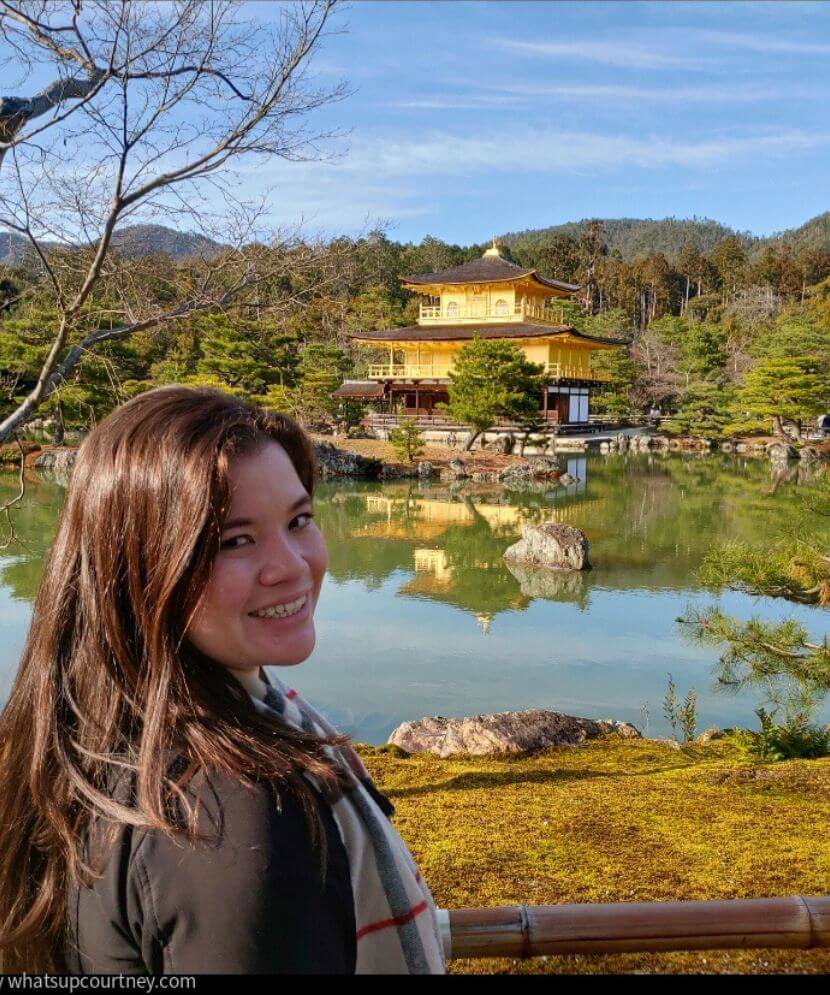
HeyWhatsupCourtney
Owner / Traveller / Content Creator
Hey! I’m Courtney, traveller and content creator behind the travel and food blog WhatsupCourtney. I’ve spent over 10 years exploring travel destinations across Asia, Europe and beyond with a particular focus on cultural experiences, adventures and their food. Instead of the traditional curated Instagram (@heywhatsupcourtney) style blogging, I am trying instead, to show you the realistic, raw, and exotic side of travel and a whole lots of food that goes with it. Because I believe food is part of the country culture and needs to be tried and shown proudly.
I have recently traveled around Shanghai China, day trips to Dubai and Paris, explored the Golden Route in Japan, and as you know I was born and raised in Jakarta Indonesia so will be providing lots of Indonesian travel tips and Newcastle Upon Tyne UK travel guides as a local.
Leave a Reply