
You are planning a trip to Kyoto, and wondering which landmarks and sightseeing things to do in Kyoto Japan that’s worth your time?
Fushimi Inari, Kiyomizu-dera, Yasaka Pagoda, Gion, Arashiyama Bamboo Forest, you probably have heard and seen of these landmarks.
Kyoto is one of my favourite places in Japan, the vibe is so different to Tokyo and Osaka.
Because Kyoto is so rich in history and culture, a lot of the main sights are temples and shrines. I love that side of the city, especially since I’m an Anime and manga nerd, Kenshin always comes to mind for Kyoto.
These are the spots I found worth the time and effort. And there’s a few that you could possibly skip depending on your length of stay, so keep reading to discover all the things to do in Kyoto that need to be on your bucket list!
5 Can’t Miss Experiences in Kyoto
- Walk through thousands of torii gates at Fushimi Inari Taisha but keep climbing past the crowds for the quiet version most people miss
- Start your morning at Kiyomizu-dera before 8am, then wander the empty streets of Higashiyama
- Skip the crowds and explore Ginkaku-ji, one of Kyoto’s most peaceful temples
- Take part in a traditional tea ceremony with kimono, a slower, more immersive, and worth doing properly
- End your day in Pontocho Alley, with dinner overlooking the river
➤Click for Table Of Contents
Table of Contents
In a Rush? My top Kyoto Hotels before we start
⭐⭐⭐Candeo Hotels Kyoto Karasuma (City centre, ryokan style, wonderful sky spa) : Check for your availabilities
⭐⭐ The Gate Hotel Kyoto (Best location in the city, rooftop bar on the Kamo River) : Check for your availabilities
⭐Kyoto Century Hotel (Best value near Kyoto Station) : Check for your availabilities
My Experience in Kyoto
And after spending 5 days in Kyoto as part of my 2 week Japan Trip in February, let me share my biggest takeaway with you, Kyoto can get very busy!
I had already read more Kyoto guides and sub reddits than I care to admit, and I went in with a plan.
One thing I decided early was that I was not going to tick every box. Kyoto has 1,600 temples and 400 shrines, and that’s quite a lot.
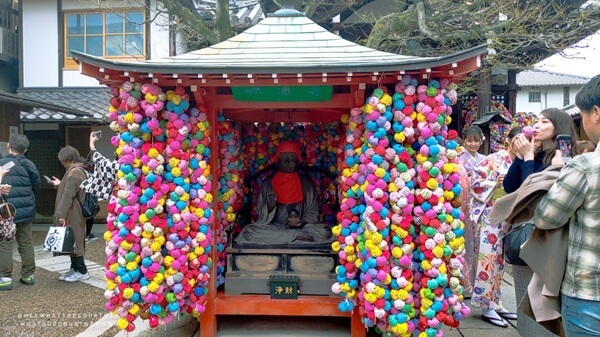
Also at each landmark, it was so lovely to wander around and find different aspects to it, like in Kyomizu dera and you can find the shrine Yasaka Koshin-do Temple and make wishes known as Kukurizaru, the ball-shaped talisman.
or do the strength test at Kiyomizu Dera Temple!
I came home with zero regrets, except one. I never made it to a Geisha show in Gion and I am still annoyed at myself about it.
If you are doing Kyoto in 4 days, have a look at my full 4-day Kyoto itinerary for the day-by-day breakdown of exactly how you can structure your 4 days in Kyoto.
Or if you are planning day trip or 1 day in Kyoto, I have a walking itinerary set up for you.
The Best Things to do in Kyoto Japan
1. Fushimi Inari Taisha: Go Early or Hike past the crowds
You know exactly which one this is. The thousands of bright orange torii gates winding up a mountain.
The hike to the top takes about 90 minutes each way and it depends on your fitness level as well. It is absolutely worth it. The views over Kyoto spread below you are stunning and you will have almost the place to yourself up there.
Half way up the trek, there is a resting spot, and a traditional cafe of sorts, and a viewing point. The way up does branch out so have a look at the signs and see which direction you want to go. Rest here for a bit and enjoy the view then head on up. It really is worth it. And you get to say you climbed all the way up!
I wrote a detailed guide on what happens if you hike Fushimi Inari all the way to the top because I think most people give up too early. If you want the context and history while you walk, booking a guide is worth it.
There’s also a night tour which I only found out about recently which looks super interesting to do. There are occasional animal sightings along the trail which adds something unexpected to the whole experience.
Book a Fushimi Inari guided walking tour here
Entry: Free. Open 24 hours. JR Nara Line from Kyoto Station, 5 minutes. Hike to the summit takes around 90 minutes each way depending on your fitness level.
2. Kiyomizu-dera Temple
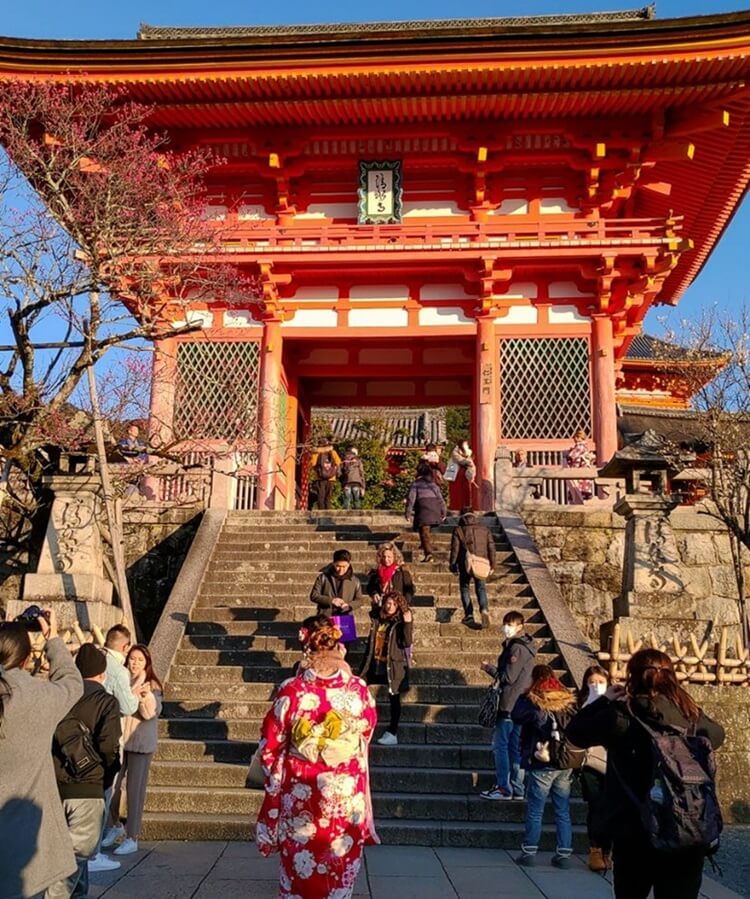
Kiyomizu-dera is one of the most famous Buddhist temples in Japan and one of the best places and experience I saw in Kyoto.
It was quite far from my hotel, and we took a bus here. Upon arriving, you do have to walk up to the main temple, the traditional shops that you pass by are so amazing. It’s a good idea to do your souvenier shopping here. There’s a lot of options.
Tip: If you want more than just photos, consider combining your visit with a walking tour around the area. You’ll pass traditional tea houses, try local sweets, and learn the story behind the “Pure Water Temple” including the three streams said to bring health, success, or love.
Also there’s a famous Baumkuchen from Kyo-Baum Kiyomizu, it was highly recommended and bought a couple for souveniers too.
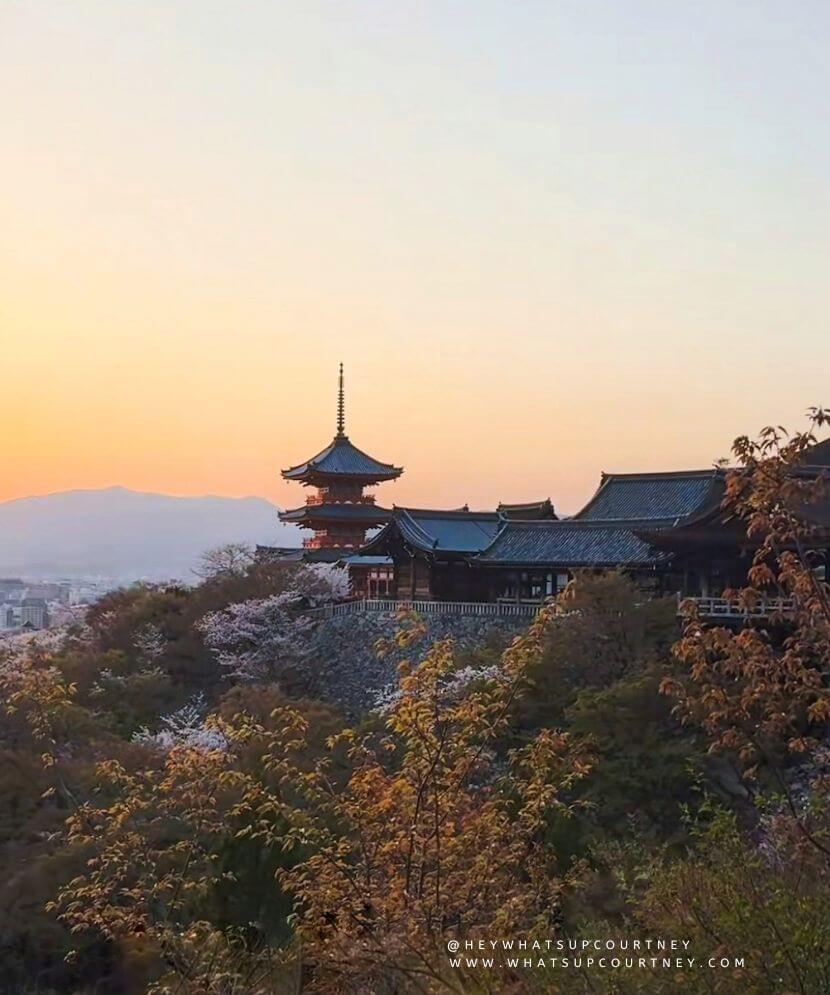
Perched off the main hall, a huge wooden stage extends 13 metres above the trees below, giving you one of the best views in Kiyomizu-dera. In spring, it’s surrounded by cherry blossoms; in autumn, deep red maples take over. Even more impressive? The entire structure was built without a single nail.
Dating back to 780 AD and part of a UNESCO World Heritage Site, Kiyomizu-dera is one of Kyoto’s most famous temples so yes, it gets busy. It’s great to come here early if you want to enjoy it with less crowds.
However, dusk is a lovely time at this spot, the lights come on, and if you are lucky to get a sunset, it’s incredible.
Travel tip for visiting temples and shrines in Japan:
If you’re planning to visit any temples or shrines in Japan, particularly the popular ones like this one, make the effort to arrive early in the morning to enjoy the temple before the crowds. You’ll be glad you arrived before the tours and crowds descend, that is, if you’re looking for a spiritual, serene experience.
Entry: 500 yen (~$3.30 USD). Opens 6am with seasonal variation. Higashiyama district, eastern Kyoto.
3. Jishu-jinja Shrine
Located within the grounds of Kiyomizu-dera, Jishu Shrine is one of those places most people walk straight past without realising. It’s easy to miss, I didn’t realise where the entrance was until my friend pointed it out.
Dedicated to the god of love and relationships, this small shrine has been drawing hopeful romantics for centuries. Its most famous feature is the pair of “Love Fortune Stones.” The idea is simple, you walk from one stone to the other with your eyes closed, and your wish for true love might just come true.
You know you had to try it at least once, and I had a good go at it, and ended up at the 2nd stone a little bit off, and it was so cute to have people cheering on. You must have a go, at least for the experience.
Look closer and you’ll spot ema (wooden wish plaques) decorated with a man holding a hammer and a rabbit, they are the symbols of luck and prosperity.
There are statues here too, and naturally, it’s become a bit of a photo stop. But beyond that, it’s a quick, slightly quirky detour that adds something a little different to your visit.
4. Yasaka Kōshin-dō
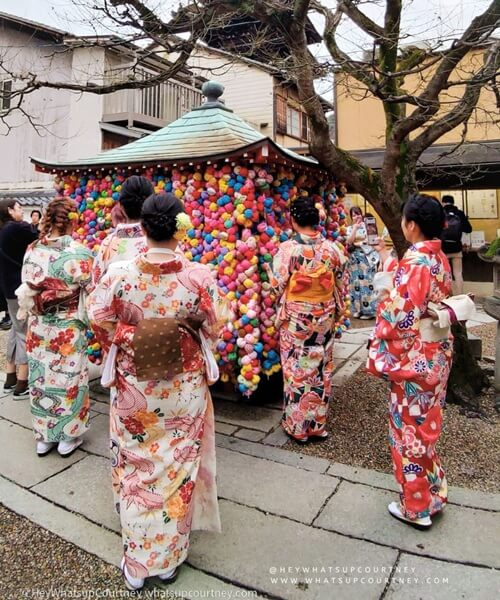
I stumbled on this shrine by accident while exploring the streets near Kiyomizu dera. So many young women here and holding these pom pom like balls all very excited and taking pictures with their kimonos.
At first glance, the temple looks so vibrant and playful, covered in hundreds and hundreds of bright, dangling “pom-poms.” I found out these are actually small monkey-shaped talismans called kukurizaru.
What you do is, worshipers write a wish on the ball (kukurizaru), and then hang it for help in losing a bad desire and getting a wish granted.
Inside, you’ll also spot references to the famous Three Wise Monkeys, tied to the temple’s spiritual focus and its guardian deity, Kōshin-san. It’s a quick stop, but a memorable one and easily one of the more unusual and unique spots in Kyoto.
5. Yasaka Pagoda
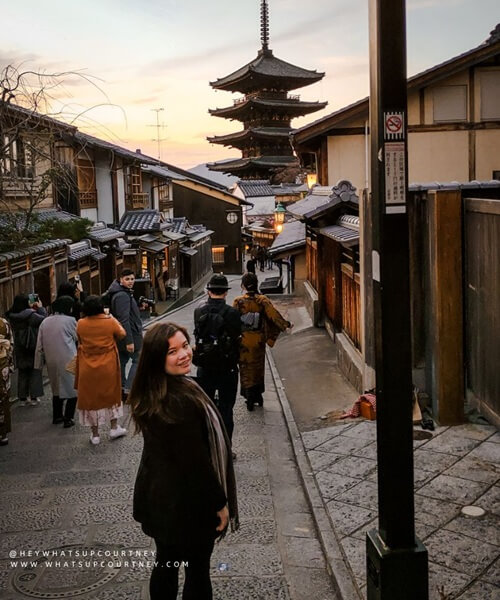
Yasaka Pagoda is one of the most photographed spots in all of Japan, and it deserves that status. The five-storey pagoda at the end of Ninenzaka, framed by traditional wooden buildings and stone-paved streets, is exactly what most people are picturing when they imagine Kyoto.
The catch is that by 9am the streets are full and by 10am the whole area is chaotic. At 7am, the lanes are empty. I walked from one end to the other in near silence, took photos without a single stranger in the background, and had one of the most peaceful mornings of the entire trip.
Pair this directly with Kiyomizu-dera, which is about a ten-minute walk away. Do both in the same early morning and you have covered two of the best sights in Kyoto before most people have had breakfast.
6. Sannenzaka & Ninenzaka
Start your morning in Sannenzaka and Ninenzaka before 8am, while the streets are still quiet (if you can). This street is lined with traditional wooden buildings, small shops, and tea houses that feels like you are back in time.
This is a good area to slow down, wander, and browse a few local shops before things get busy later in the day. By mid-morning, it becomes difficult to move comfortably through here, especially around the narrower sections.
From here, it’s a short walk to one of Kyoto’s most recognisable landmarks, Yasaka Pagoda. If you want photos without crowds, go early in the morning or later in the evening when the streets are much calmer and the light is better.
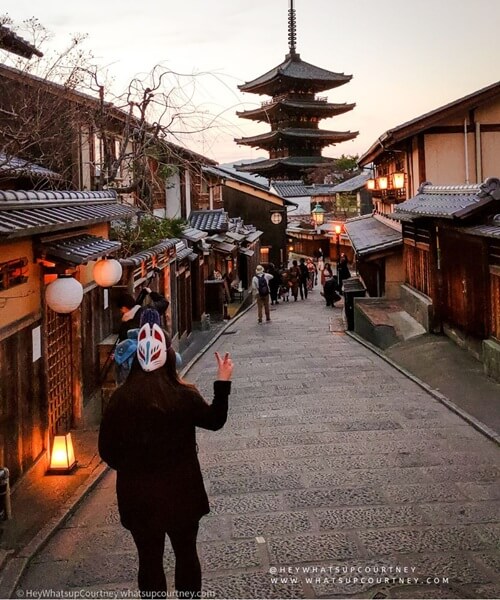
7. Wander through the streets of Gion
One of my favourite things to do in Kyoto in the evening is simply wander through Gion after sunset.
The lantern-lit streets here feel almost frozen in time, especially around Shirakawa Minami-dori (often called Shimbashi), a beautifully preserved historic street lined with traditional wooden machiya houses and narrow canals.
It’s easily one of the prettiest areas in Kyoto and feels even more atmospheric once the crowds begin to thin out.
While exploring the neighbourhood, make sure to stop by the iconic Gion Tatsumi Bridge, a tiny but famous bridge that many travellers recognise from Memoirs of Geisha if you have read the book.
Book a Gion Walking tour and meet a Geisha Meiko properly
Also Book a Kyoto: Gion Magical Night Walking Tour , Gion at night is sensationally a different vibe to the day time.
Tip: Be warn that some areas of Gion has been closed off due to the harassment of the Geishas, so please do not do this and always be respectful to the Geishas and locals. Just remember please don’t do things you don’t want people to do to you :).
8. Kennin-ji Temple in Gion: The One Most People Walk Past
Entry: 600 yen (~$4 USD). Opens 10am. Central Gion.
Most visitors walk through Gion without realising that one of Kyoto’s oldest Zen temples is sitting quietly in the middle of it.
Kennin-ji was founded in 1202. It sits behind the teahouses and machiya townhouses and is one of the least crowded significant temples in the city despite its central location.
The twin dragons ceiling mural painted across the ceiling of the main hall stops you mid-step. The scale of it is unexpected. The Zen gardens surrounding the building are the kind of thing you sit down in front of and lose 20 minutes without noticing.
If you’re already in Gion in the morning, this is a 10-minute detour that most people you know will not have done.
9. Pontocho Alley for Dinner: The Best Evening in Kyoto
Central Kyoto, running parallel to the Kamo River. Most restaurants open from 5pm. Kawayuka platforms up from May through September.
A narrow lane running parallel to the Kamo River, lined with restaurants that back onto the water. From May through September, most of them extend outdoor platforms over the river called kawayuka. You eat with the Kamo River flowing beneath you and the city lights reflecting on the surface.
Pick any restaurant with an outdoor platform and a menu you like the look of. Order what they’re proud of. Watch the river. This is a better evening than almost anything else on this list, and it costs nothing to walk into.
10. Do a Tea Ceremony dressed in traditional Kimono
There are so many places you can do a tea ceremony in Kyoto and also while dressed up in a Kimono or Yukata. We didn’t book this the first time we were in Japan.
Though few of my friends have done it, and they were pleasantly surprised and enjoyed it immensely.
They said kimono fitting took about half an hour and the garments were beautiful. They had choices over patterns and styles. The tea master who led the ceremony walked them through the full ritual properly, how to hold the bowl, how to rotate it, how to make the matcha from scratch. Of course the tasting the tea is a must.
Book a Kyoto tea ceremony with kimono here
11. Do a Day Trip to Nara and bow at the deers
I did this as a day trip from Kyoto and it was one of the highlights of my entire Japan trip. My full Nara day trip guide covers the everything you need to know about Nara.
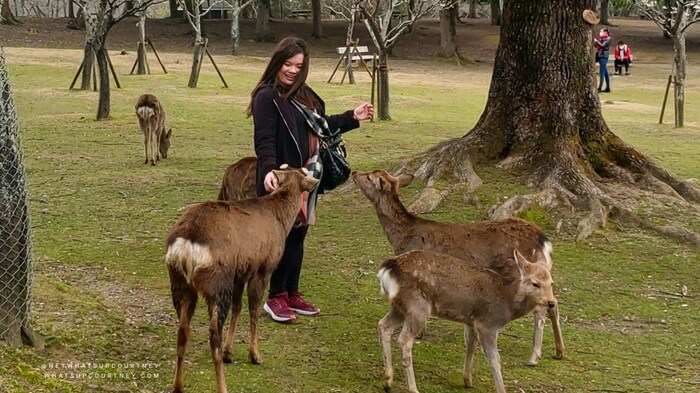
Nara is a small historic town about 45 minutes from Kyoto by the JR Nara Line, and it has a park in the center of the city where deers roam completely free.
Buy the deer crackers, and you’ll find the stalls dotted around. and bow to a deer, it will bow back and feed it a cracker.
Some of them are very naughty and might bite you bump, or grab you for attention if they know you have crackers. One ate my phone cable while charging the battery bank, dare I say it probably thought it was food.
The Todai-ji Temple inside the park is worth the entry fee. The Great Buddha statue inside is so big in a way that photographs do not prepare you for.
And do crawl through the pillar for good luck, find out the full story in my guide to Nara day trip
JR Nara Line from Kyoto Station, around 45 minutes. Nara Park entry: Free. Todai-ji Temple: 600 yen (~$4 USD).
12. Do day trips to Osaka, Himeji Castle
Osaka (15 minutes by Shinkansen)
The easiest and most obvious day trip. Osaka has a completely different energy to Kyoto. Think street food, neon lights, and a more fast-paced feel. Head to Dotonbori for food and atmosphere, and stop by Osaka Castle if you want something more traditional. Definitely go for a day trip, if you are not planning to stay in Osaka for a few days.
Himeji (1 hour–1 hour 30 minutes)
Home to Himeji Castle, often called the “White Heron Castle.” It’s one of the best-preserved castles in Japan and a UNESCO-listed site.
➤ Book a guided Nara day trip from Kyoto here
13. Nishiki Market
Nishiki Market is easily one of the most convenient places to sample Kyoto’s food scene, especially if it’s your first time in the city. Everything is in one place, it’s easy to navigate, and you can try a wide range of dishes without committing to a full restaurant. That said, it is very much geared towards visitors. Prices are higher than elsewhere, and many stalls lean towards quick, visual-friendly snacks rather than everyday local food.
The way to approach it is simple: go for the experience, not necessarily the value. Try a few things, enjoy the atmosphere, then balance it out with a proper meal at a local restaurant later. Used like that, it’s still absolutely worth your time.
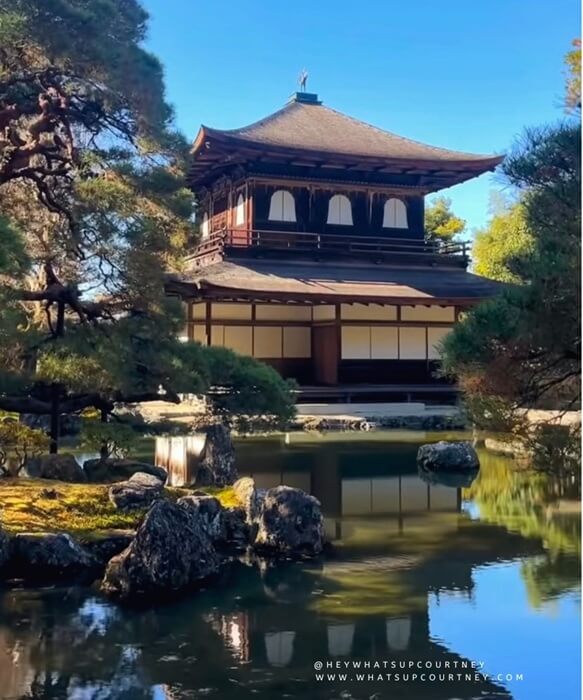
14. Ginkaku-ji (the Silver Pavilion): My Favorite Temple in Kyoto
Ginkaku-ji did not make every “must-see” list I read before going, which is exactly why I ended up enjoying it so much.
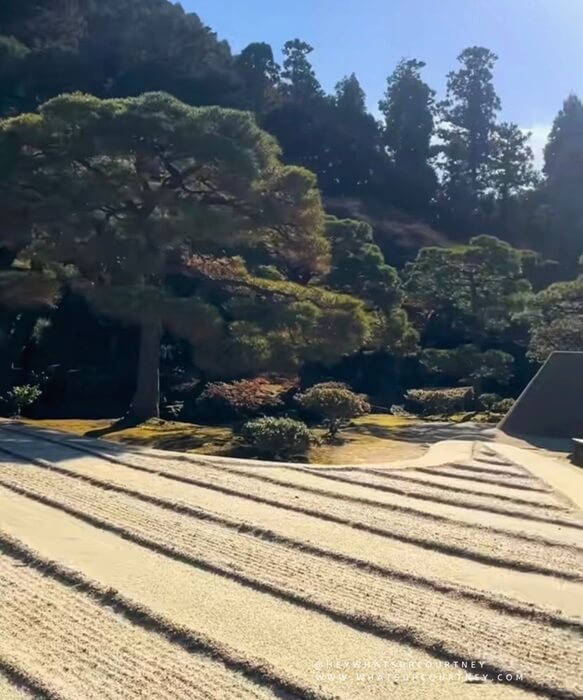
The Silver Pavilion is a Zen temple built in 1482. The surrounding gardens are some of the most carefully designed I have ever seen at a Japanese site, with a famous sand garden shaped into a cone called Kogetsudai that is raked into geometric patterns every single day. It is one of those small details that makes you realize how seriously Japanese aesthetic tradition is taken.
I stayed in a traditional ryokan a five-minute walk from here, which meant I was through the gates shortly after they opened at 8:30am. It was quiet in a way that Fushimi Inari never quite managed to be. The moss gardens, the walk up to the viewpoint behind the temple, the sound of absolutely nothing except birds. That morning was one of my favorites from the whole Japan trip.
Ginkaku-ji and the Philosopher’s Path are right next to each other. Do both in the same morning, starting early. The Philosopher’s Path is particularly special during cherry blossom season.
If cherry blossoms are the reason you are in Kyoto, check my cherry blossom guide for Japan 2026 to get the timing right.
Entry: 500 yen (~$3.30 USD). Opens 8:30am. Northern Higashiyama.
15. The Philosopher’s Path, Come for the Cherry Blossoms
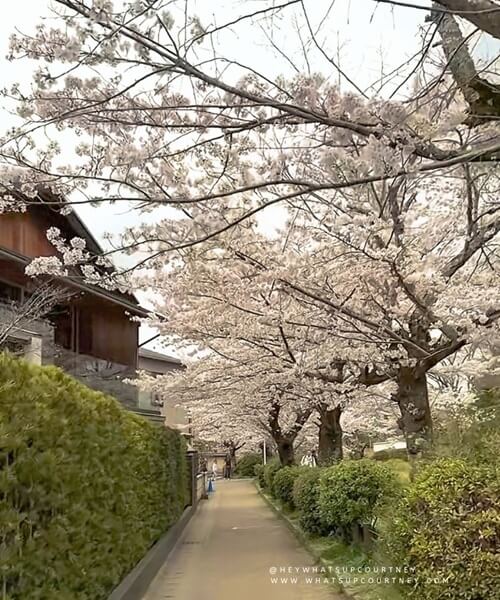
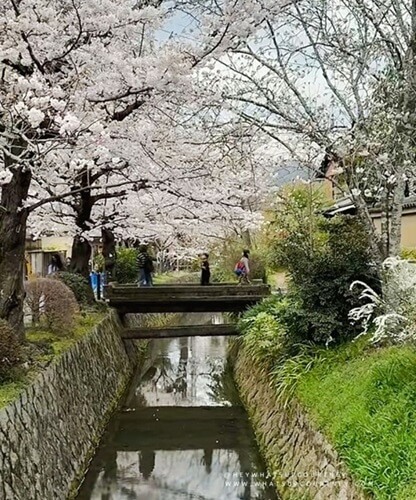
The Philosopher’s Path is a two-kilometer canal walk through northern Higashiyama, lined on both sides with cherry trees. The path gets its name from a philosopher called Nishida Kitaro who reportedly used it for his daily meditative walk, which is an extremely pleasant thing to imagine.
I walked it in autumn and it was a lovely stroll but not life-changing. In spring, when the trees are in full bloom and the petals drift down onto the water, it becomes one of the most beautiful stretches in Japan. If you are visiting during cherry blossom season, this is a non-negotiable.
If you are visiting at other times of year, it is still worth a walk, especially since Ginkaku-ji is right at the top end. Just do not make it the centerpiece of your trip unless the timing is right.
Entry: Free. Best in cherry blossom season late March to early April, or autumn. Northern Higashiyama.
16. Jojakko-ji and the Hidden Temple Route
If you are at Arashiyama Bamboo forest, you have to walk around here away from th emain bamboo forest and you will come across Jojakko-ji Temple and also Adashino Nenbutsu-ji.
Both temples are beautiful and almost with no crowds.
Adashino Nenbutsu-ji has its own small bamboo section, peaceful, beautiful, and breathing room. My full guide on whether the Arashiyama Bamboo Forest is worth visiting goes into detail on what to do if you feel the same way I did.
Jojakko-ji in particular has beautiful moss-covered stone steps, a five-storey pagoda, and very peaceful.
Entry: 500 yen (~$3.30 USD) for Jojakko-ji. Arashiyama, western Kyoto.
17. Kodai-ji Temple
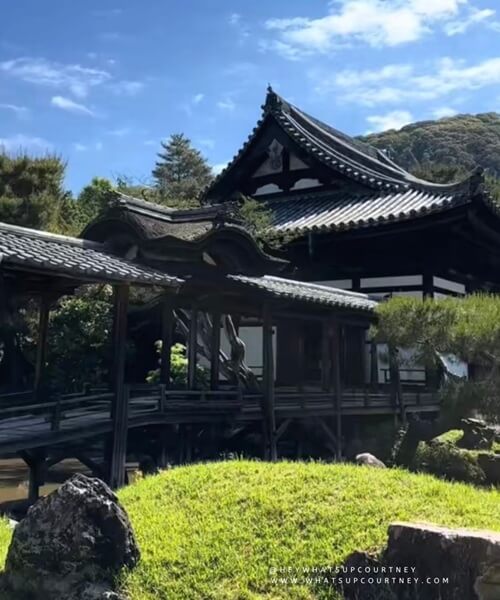
Kodai-ji temple in the Higashiyama area ended up being one of the more memorable stops of my time in Kyoto, mainly because it feels more complete than a typical temple visit. There are gardens, viewpoints, quiet walking paths, and a much calmer atmosphere compared to some of the better-known spots nearby.
The temple was originally built in memory of Toyotomi Hideyoshi and his wife Nene, and that history still shapes how the grounds feel today. The highlight for me was the landscaped Zen garden with its elevated wooden walkway overlooking the pond, especially in the early part of the day when it’s quiet enough to take it in properly.
Deeper inside the grounds, you’ll also find a small mausoleum dedicated to Hideyoshi and Nene, set in a more enclosed, decorated space that feels noticeably different from the open gardens.
Another detail worth slowing down for is the tea house area. These are among the oldest preserved tea houses in Japan, associated with tea master Sen no Rikyū. Even if you’re not deeply into tea culture, it gives you a clearer sense of how seriously the tea ceremony tradition is treated here.
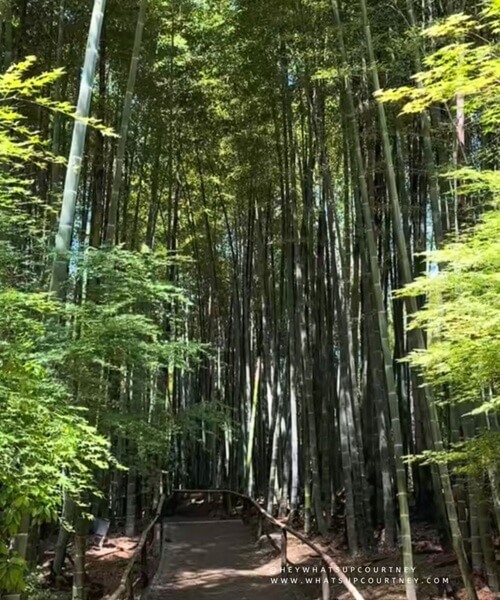
Towards the exit, the path opens into a quieter bamboo grove along Nene’s Path. This is one of the better low-crowd alternatives if you want that bamboo setting without the intensity of Arashiyama. It’s smaller, but far more relaxed, especially later in the day when most visitors have moved on.
18. TeamLab Biovortex Kyoto
Tickets: 3,600 to 5,200 yen (~$23 to $34 USD) depending on date. Opens 9am daily. 7-minute walk from Kyoto Station Hachijo East Gate. Book in advance.
I’ve been to TeamLab in Tokyo, not this Kyoto version. TeamLab Biovortex opened in October 2025, so I haven’t had the chance to visit yet. But based on how good the Tokyo experience was, I’d add this to this list of things to do in Kyoto Japan.
This is now Japan’s largest TeamLab exhibition, covering 10,000 square metres with over 50 immersive installations. The installations respond to you. Stand still and flowers bloom around you. Touch them and they scatter. Walk through and your footprints light up the floor. Several artworks are world premieres that exist nowhere else.
Book your tickets to TeamLab Biovortex Kyoto via Klook
Tip: Set an alarm for how long you want to stay in here, it’s like a casino, where you will not realise how long you have been inside (no clocks or windows). We stayed longer than we anticipated when we were in Tokyo Teamlab, there’s so many rooms to explore and enjoy and forgot the time.
Three Things I Would Skip in Kyoto (My Honest Take)
1. The Arashiyama Bamboo Forest (Main Path)
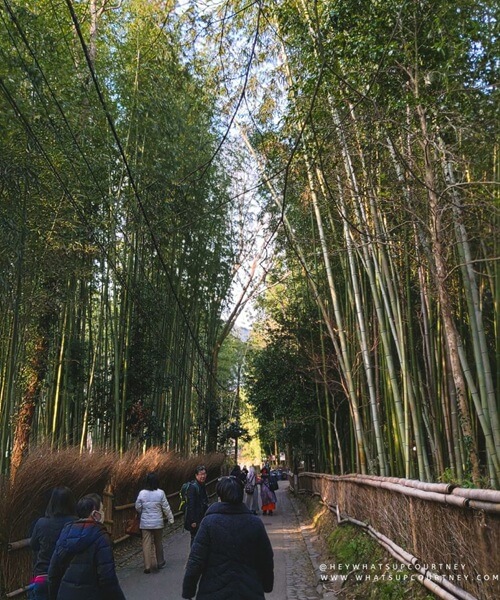
I have nothing against the bamboo forest. For me, I loved it, it was very peaceful in the morning, took advantage for the peace to take pictures and enjoy the moment.
However, during the peak morning time, it was for me incredibly busy, and I’m not a big fan of crowds. The main bamboo grove is one of those places that looks spectacular in photos taken at 5am when no one is there, and is an underwhelming with the crowds the rest of the time.
My recommendation is to go to Arashiyama but not only for the bamboo specifically, but also explore the temples and the hidden paths, and monkey park and more.
2. Kinkaku-ji (The Golden Pavilion)
I am going to say something that will be unpopular with approximately every travel guide ever written, I do not think Kinkaku-ji is worth your time on a short trip to Kyoto.
When I went there, it was during lunch time, we paid our entry fee, follow along the path to a viewing platform and you look at the golden pavilion from across a pond. and surprisingly it’s quite small (from the distant).
You can of course walk around it, and it was busy so you might have to wait or find a spot by the fence to get a good picture.
Compare that to Ginkaku-ji, where you actually walk through the temple grounds, through the gardens, up to a viewpoint, and spend time inside the space. The Silver Pavilion is less famous, more intimate, and in my opinion far more worth the morning.
If you have many days in Kyoto and have done everything else, go to Kinkaku-ji. If your time is limited, spend it somewhere you can actually experience rather than observe from a distance.
3. Nishiki Market
Before the pandemic, Nishiki Market used to be popular with the locals to get local produce but unfortutnaely lots of shops took a hit during this time, and now new shops have opened. These new spot are more catered towards tourism and fair enough I say.
That said it is quite overpriced, especially the skewers and sushi and seafood items so keep that in mind when you go. It’s fair to visit and wander around and get the takoyaki, it was delicious.
Choose your shop wisely, if there’s a queue and mainly locals, best bet it would be nice.
Entry: Free. Most stalls open 9am to 6pm. Downtown Kyoto, Kawaramachi area.
Where to Stay in Kyoto
For everything I did in Kyoto, being downtown made my life significantly easier. I started in a ryokan near Ginkaku-ji for the first two nights, which was a beautiful experience, and then moved downtown for the final two. The difference in how much ground I could cover each day was enormous.
• Downtown Kyoto (Kawaramachi): the right choice for most first-timers. Walking distance to Nishiki Market, Gion, and the Kamo River. Both subway lines accessible.
• Gion: the most atmospheric area to stay in, slightly quieter at night, beautiful lanes. Great for couples.
• Northern Higashiyama: best for ryokan stays and being close to Ginkaku-ji. Less practical for covering the whole city.
• Kyoto Station area: the practical choice if you are doing lots of day trips to Nara, Osaka, or Hiroshima.
Check all Kyoto accommodation options and compare prices
Practical Tips for Kyoto
• Getting around: Kyoto’s buses are reliable but slow and very crowded during peak season. Taxis and ride apps are worth using for early morning temple visits when buses are not as frequent. The JR Nara Line from Kyoto Station to Fushimi Inari takes five minutes and is the easiest transport decision you will make all trip.
• Early mornings are not optional: the difference between a 7am visit and a 10am visit at most Kyoto sights is the difference between peaceful and chaotic.
• Cash: most temple entry fees are cash only. Carry some money with you. ATMs at 7-Eleven and Japan Post are reliable for foreign cards.
• Staying connected: you will be navigating, translating menus, and looking things up constantly. I have used Saily and got a Japan eSIM and it’s the easiest way to have data from the moment you land.
I also use NordVPN when I am using public wifi in cafes and train stations to keep my connection secure. Get NordVPN here and set it up before you travel.
FAQs About Things to Do in Kyoto
What is the single best thing to do in Kyoto?
Fushimi Inari Shrine. It is the most visually iconic thing in the city and nothing else comes close. Go early or hike past the crowds.
How many days do you need in Kyoto?
Three days minimum to see the highlights properly. Four days is the sweet spot. More than that and you can start going deeper into the quieter temples and neighbourhoods.
Is the tea ceremony worth it in Kyoto?
Yes. I went in skeptical and came out converted. Book the version that includes kimono dress-up. It is more immersive and the photos are significantly better.
What is free to do in Kyoto?
Fushimi Inari is free and open 24 hours. Gion is free to walk through. The Philosopher’s Path is free. Many smaller shrines have no entry fee. You can easily have a full day in Kyoto spending very little.
Is Arashiyama Bamboo Forest worth it?
Here’s the thing, the main path is overcrowded when the tours come in and during peak hours and if you are not a fan of crowds like myself, it can get overwhelming. There are other areas and paths with bamboos around, and the surrounding temples are lovely. Go for the area, not specifically for the bamboo. I have a full guide on what you can do in Arashiyama in my Arashiyama Bamboo Forest guide.
Should I do a day trip to Nara from Kyoto?
Yes, without hesitation. It is 45 minutes by train, the deer park is unlike anything else in Japan, and the Todai-ji temple is one of the most impressive things I saw on the whole trip. My full Nara day trip guide has everything you need.
Is TeamLab Biovortex Kyoto worth it?
If you have four or more days in Kyoto, yes. It’s Japan’s largest TeamLab exhibition, opened in October 2025. Tickets run from 3,600 to 5,200 yen (~$23 to $34 USD) and need to be booked in advance. Give this place at least three hours, though you may have to keep track of your time inside. Great for kids too.
How do I avoid crowds in Kyoto?
Arrive early at every major site. Before 8am at Kiyomizudera and Yasaka Pagoda. By 9am at Fushimi Inari. Walk further than most people bother to in Arashiyama. And use the hidden gems section above to find the places most visitors walk straight past.
Concluding on my things to do in Kyoto
Kyoto is the kind of city that does not need much help from a guide. You can walk in almost any direction and you will find something worth stopping at.
Pick the experiences that interest you, if you are able to go early to the crowded ones like the forest or Fushimi Inari, definitely do it, and give yourself time to wander around.
The best parts of my time in Kyoto were the things that were not on any list, like the quiet hour I spent at Ginkaku-ji before the gates were even officially open, or the last seating at Gyoza Taizou with a group of strangers who became the best dinner company I had all trip.
I hope this list has been helpful for planning your trip to Kyoto and rest of Japan. Hope you have the best time!
Courtney xx
Affiliate disclosure: Some links in this post are affiliate links. If you book through them I may earn a small commission at no extra cost to you. I only recommend experiences and hotels I have personally visited or thoroughly researched.
Find my other Japan Travel Guides below:
4 days in Kyoto itinerary: the full version of this plan across four days
How to Spend 1 Day in Kyoto Without Feeling Rushed (2026)
• Fushimi Inari: what happens if you keep walking to the top?
• Is Arashiyama Bamboo Forest a tourist trap?: my honest take
• Is Arashiyama Monkey Park worth visiting?
Japan Travel Tips:
My Japan Travel Guide 2026: First Timer’s Itinerary and Everything You Need to Know
• Japan travel tips for first-timers: The Japan Travel tips I have learnt on my trip
• Best time to see cherry blossoms in Japan 2026: the complete sakura timing guide
Japan Day trip guides:
• Nara day trip from Kyoto or Osaka: deer, temples, and the best pounded mochi
Where to Stay in Hakone (2026): Best Areas, Ryokans & Hotels (What I’d Book Again)
Hakone Japan: 10 Must-Do Experiences & Things to do in Hakone
The 10 Best Things to Do in Odawara Japan (Why you should visit + Day Trip Itinerary)
Japan Hotel Reviews:
Candeo Hotels Roppongi Review: Is This Tokyo’s Best Value Luxury Stay?
Candeo Hotels Shimbashi Review: The Tokyo Hotel That Surprised Me
Candeo Hotels Osaka Namba with Japanese Breakfast & Sky Spa 2025 Review
Tokyo Travel Guides:
Roppongi Tokyo: 10 Things to Do, See & Love in the City That Never Sleeps
Leave a Reply