
Every person in this world knows about Punch in Iwataki Zoo Japan who is the most adorable monkey in the world by now. He is a breed of Japanese macaques monkeys known in Japan, and there’s a place in Kyoto where they run wild and we, the humans are in a cage observing them (rightfully so). This place is called Arashiyama Monkey Park Iwatayama.
If you are already visiting the Arashiyama Bamboo forest, then you definitely should go and visit this monkey park. It’s within the same area.
Every guide about Arashiyama Monkey Park Iwatayama will probably say the same thing that it is a 20 minute walk to the top. This is technically accurate similar in the way that calling Fushimi Inari a walk to some gates is technically accurate.
Firstly it depends on your walking speed and fitness, second it is an uphill walk, I’m not sugarcoating this, and I’m semi fit, it gets somewhat steep at some points but moderately ok, but yes it’s uphill!
I’ve put together this Monkey park guide to tell you if the monkey park in Kyoto is worth visiting, and what to expect realistically. I found this so much more fun than the bamboo forest though I already was in awe being there. Also it’s like seeing Punchi the monkey close by (well his peers), and in their natural environment.
Here is everything you need to know before you go. I will also recommend some tours and experiences along the article for your consideration.
In a rush? Here are my top picks Hotels in Kyoto if you plan to stay:
⭐ The Thousand Kyoto : modern, peaceful and right next to Kyoto Station. Perfect if you’re coming in by train.
⭐ Gion Yoshi-Ima Ryokan : a traditional tatami-room stay right in Gion for the full Japanese experience, stunning rooms and good location as well.
⭐ Candeo Hotels Kyoto Karasuma Rokkaku : stylish, clean and central without the huge price tag, plus great decor and lovely rooms.
Tip: Book early. Kyoto’s tourism has bounced back strong in 2025 and prices rise closer to travel dates.
My experience at Arashiyama Monkey Park in Kyoto
The monkey park actually surprised me more than the bamboo forest did. At first, it was one of the things to do while you are at Arashiyama and after experiencing it, I loved it!
After visiting to both the Arashiyama bamboo forest and now the monkey park, I would say I enjoyed the monkey park bit more.
It was a different experience, and adore it because it was the Japanese macaques monkey running around in the wild, as wild as they can be cause there are no restraints.
We visited the monkey park after the bamboo forest, walk about 20 to 30 minutes, you will have to cross the Togetsukyo Bridge, then turn left along the south bank of the Katsura River, and you will find the entrance gate at the bottom of a forested hill.
I paid my 800 yen in cash, pushed through the turnstile, and started up the path. The walk up took us about 30 minutes, we took some breaks in between, taking pictures and videos along the way. It was quite an uphill for me anyway, but luckily it wasn’t super busy when we walked up. I hate that feeling of people walking behind you especially when you are not as fit as them (in my mind anyway).
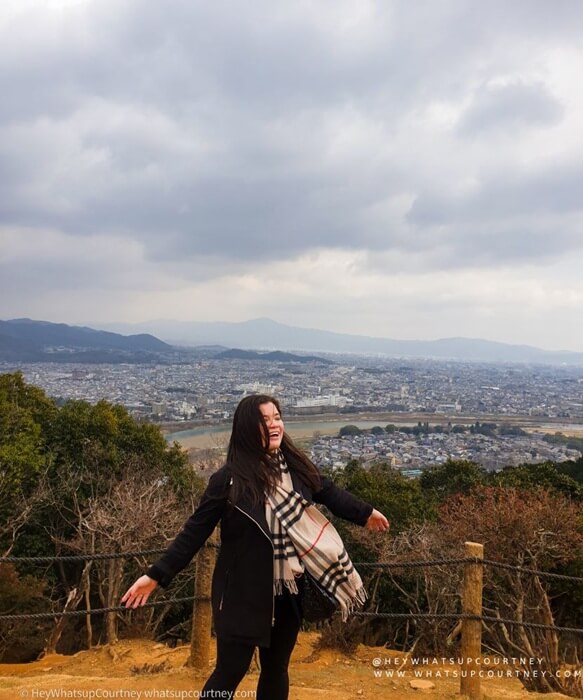
It was quite scenic walk actually, quite enjoyed it, and when you reached the summit, you are standing in an open area while a wild Japanese macaque walked past me at approximately arm’s length and paid absolutely no attention to me at all.
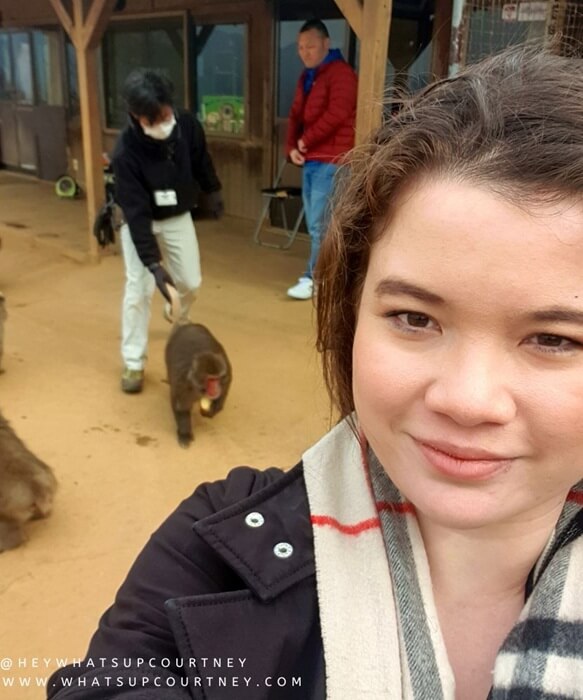
There is a keeper there watching the monkeys, protecting the monkeys from us humans of course. I love it. especially that they are in the natural environment. Fed the ever hungry monkeys in the hut itself, and they were so cute! They also clearly have a bond with the caretaker as well.
I say it was worth visiting the Monkey park.
And if you are staying in Kyoto for over 4 days, I have a 4 day itinerary in Kyoto to help you plan your trip.
Finding the entrance to Arashiyama Monkey Park
The entrance is easy to miss if you are not looking for it.
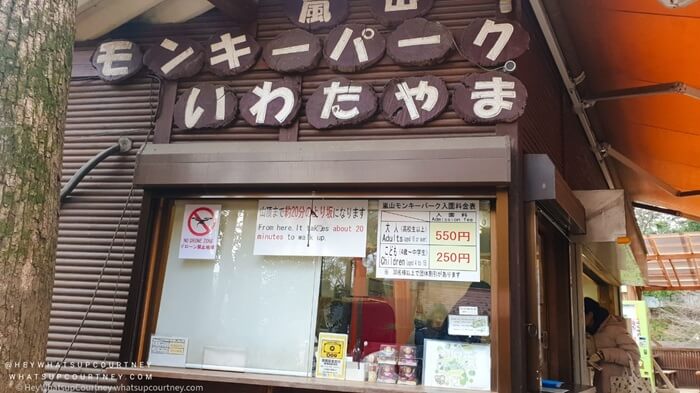
From the bamboo forest, walk south toward the Togetsukyo Bridge. Cross it. On the south side, turn left and walk upstream along the river for about fifty metres. You will see a wooden gate that looks like a small shrine entrance. This is the ticket office and the start of the trail. You pay at the bottom, not at the top.
It is about 20 to 30 minutes on foot from the bamboo grove entrance to the monkey park gate. The walk along the south bank of the river is pleasant and was bit windy that morning.
| Getting to the monkey park: From the bamboo grove: 15 to 25 minute walk south then across the Togetsukyo Bridge. From Saga-Arashiyama JR Station: 20 to 25 minutes on foot. Address: 61 Nakaoshitacho, Nishikyo Ward, Kyoto 616-0004. Open: 9am to 4pm. Closed on some public holidays and in heavy rain or snow. Admission: 800 yen adults, 400 yen children aged 4 to middle school. Under 4 free. Cash only. Pay at the gate at the bottom, not at the top. |
The hike to Arashiyama Monkey Park
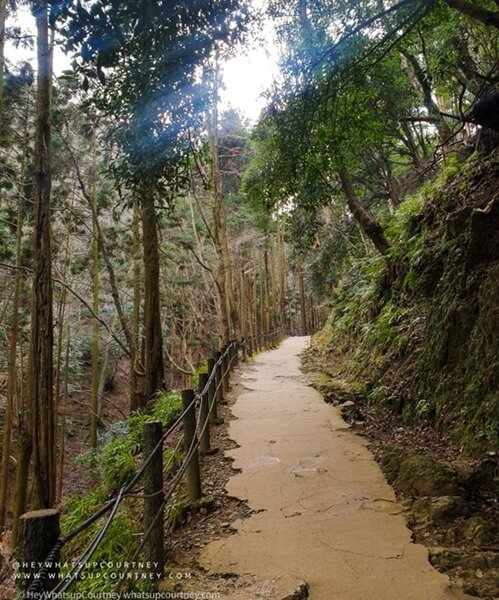
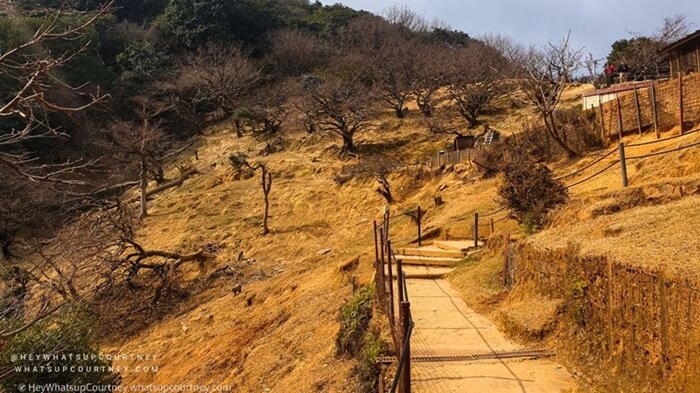
The sign at the gate says 20 minutes. I would say 25 to 35 minutes depending on your fitness, walking pace, if you pause at times for pics and vids and of course the weather. The path is paved in stone for the first section, then becomes a forest trail with tree roots and uneven ground. The incline is sustained rather than gradual, meaning it does not flatten out much once it starts climbing.
In summer this is a real workout. The humidity in Kyoto in July and August turns a thirty-minute climb into something that requires water and sensible clothing. I went in late spring and it was warm enough to need a layer removed halfway up. In winter and autumn I can imagine it would be significantly easier as it’s not as humid.
There are benches at intervals along the path and information boards about the monkeys and the ecology of the mountain. Complete godsend in my books. I love reading those information boards, don’t you?
About halfway up the monkeys start appearing. Not at the summit. On the path itself. They are coming and going from the mountain freely, and you will probably see your first one before you have any idea it is there. It is sitting on a rock at the side of the trail and it does not look up when you pass.
What is on the top of Kyoto Monkey Park?
The summit is an open area at 160 metres above sea level. Kyoto is visible in every direction, and rooftops extending toward mountains on three sides and they said you can see Osaka on a clear days.
The macaques monkeys are everywhere. I was told about 120 of them live on this mountain and they roam wherever they like which is so good! They are through the summit area, across the viewing platform, along the path back down. They sit in the trees. They groom each other on the benches. They walk past visitors and they are not that bothered with us humans.
They know they want one thing and thats food, and they know it’s in the feeding hut.
The rules are posted clearly in multiple languages. No eye contact, which they read as a challenge. No showing food outside the designated area, which will cause an immediate response. No touching. I follow all of them and feel correspondingly ignored, which is exactly right.
I have a list of the best sightseeing things to do in Kyoto Japan, you can read what you can do while you are here.
What’s the monkey park feeding hut?
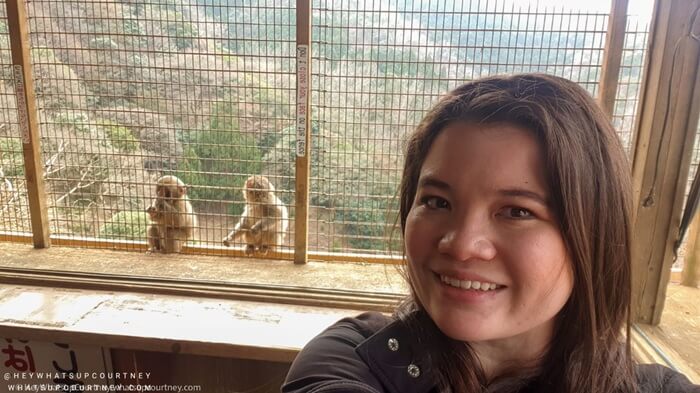
So at the summit there is a small wooden hut with mesh wire walls. This is the feeding area, and the arrangement is the opposite of what you expect.
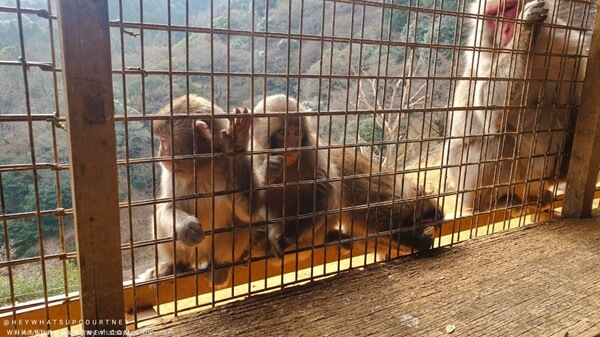
You are inside the hut. The monkeys are outside it, pressing against the mesh. You buy a small bag of peanuts or apple pieces for 100 yen (it was 100 Yen when we went) from the staff inside.
You can then find an empty spot and push the pieces through the mesh with your fingertips, and the monkeys will enthusiastically take them. They look at you with their “puppy eyes”, feed me! One baby monkey had their food taken by an older monkey, so naughty!
Best believe that I think this concept is brilliant, we are in the cage as these gorgeous monkeys are freely roaming which is incredible, as it should be.
Are the monkeys at Arashiyama Monkey Park Iwatayama dangerous?
The monkeys at Arashiyama Monkey Park Iwatayama are wild animals, but they are very used to people. Most of the time they ignore visitors completely unless food is involved.
The park has a few simple rules that make things work smoothly such as do not make direct eye contact, do not show food outside the feeding hut, and do not try to touch them. Follow those rules and the monkeys mostly treat you like another tree on the mountain.
If you are looking for experiences and things to do in Kyoto, here are some suggestions:
If you are looking for a fun things to do in Kyoto, you can get this fun Kyoto Samurai Experience or train like a samurai with this Samurai Training with Modern day Musashi in Kyoto
and this is so good with kids too Ramen Cooking Class at Ramen Factory in Kyoto
or this amazing experience KYOTO Tea Ceremony with kimono near by Imamiya Jinjya Shrine
The sites I use for booking experiences and Tours: Getyourguide | Viator
There’s always staff around to monitor the monkeys at the monkey park and serious incidents are rare. The biggest risk is usually something minor, like a curious macaque investigating a hat, a bag strap, or anything that looks interesting.
In other words, if you respect their space and you will probably have a calm visit.
A few things I did not expect about the monkeys
The monkeys in the monkey park Kyoto are Japanese macaque, sometimes called snow monkeys. They are the northernmost living monkeys in the world and can survive winters with real snow.
As I mentioned before there’s about 120 macaques thats living on the mountain above Arashiyama, and the troop has a clear social hierarchy. If you watch them for a few minutes you will see grooming sessions, small arguments, and the occasional dramatic chase across the grass.
They are also extremely observant. If one monkey notices someone feeding peanuts in the hut, several others usually appear within seconds. They always know if food is popping up.
How to leave the Arashiyama Monkey Park Iwatayama?
When you had your fun feeding the monkeys and taking pictures, and enjoying the area, the way out is quite simple. Its literally the opposite end of where you arrive. Across the space. You descent downhill, it’s not very steep actually, the path is winding and more flat in a way than the way upwards.
Things to do around Arashiyama Monkey Park Iwatayama
There are other things to do around the Arashiyama Monkey Park Iwatayama in Kyoto if you fancy staying around for a bit before heading back to central Kyoto.
The South Side of the River
Coming back down the mountain takes about fifteen to twenty minutes and lands you at the gate on the south bank of the Katsura River. Most people cross straight back over the Togetsukyo Bridge to the main Arashiyama tourist strip. Worth spending twenty minutes on the south side before you do.
Arashiyama Park (Koen) and the riverside
The park running along the south bank near the bridge is quiet in a way the north bank is not. Benches, cherry trees, a view of the bridge and mountains from the downstream angle that is significantly more composed than the view from the bridge itself. Almost no tourists. In spring the cherry blossoms here fall onto the river and the path and it is the version of Arashiyama that looks most like a classical Japanese painting.
I sit here for a while after coming down. My legs appreciated it. The light on the water is doing something good.
The Togetsukyo Bridge
Cross back over the bridge slowly. It is 155 metres long and dates originally to 836, though the current structure is a 1930s reconstruction. The name means Moon Crossing Bridge, from a story about Emperor Kameyama watching the moon appear to cross the bridge during a boat party. The view looking east from the middle of the bridge, with the forested mountain slopes behind and the river below, is the photograph that appears on every Arashiyama postcard. From this angle it earns it.
Arabica Kyoto and food along the river
% Arabica has a branch at the corner of the bridge on the north side. After a morning of bamboo forest and monkey park and the climb and the descent, this is exactly the right stop. The queue on a busy morning can be fifteen to twenty minutes but it moves quite fast. The coffee is pretty good.
For food, the tourist strip heading east from the bridge has restaurants at every price point. Yudofu tofu sets are the local speciality. If you want something quick and inexpensive, the stalls along the approach to the bamboo grove are still the right answer: warabi mochi, matcha soft serve, skewers. Eat standing up and keep moving.
If you have more time: The Sagano Train and the Hozu River
The Sagano Romantic Train
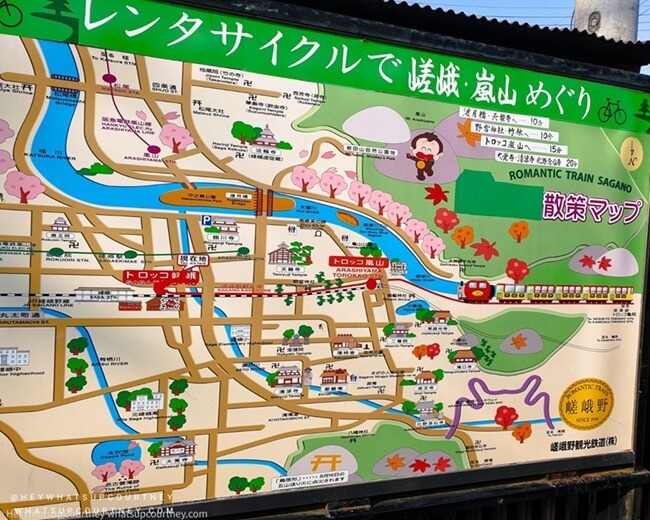
Near JR Saga-Arashiyama Station is Torokko Saga Station, the departure point for the Sagano Scenic Railway. The train runs 7.3km along the Hozu River gorge to Torokko Kameoka Station, with open-sided carriages and views of forested mountains and river rapids. The journey takes about 25 minutes and costs 880 yen each way.
It is unashamedly a tourist train and it is genuinely good. In cherry blossom season and autumn the gorge views are the reason Kyoto regulars plan their trips around it. Book ahead in peak seasons as it sells out.
Hozu River Boat Trip
From Kameoka, boats run downstream along the Hozu River gorge back to Arashiyama, about 16km, taking around two hours. The boats are flat-bottomed wooden vessels steered by boatmen using long poles, and the route passes through narrow gorges and rapids that are completely inaccessible by road.
The combination most people do: Sagano train from Arashiyama to Kameoka (25 minutes), then boat back to Arashiyama (2 hours). You see the gorge from both angles and arrive back by river. It adds half a day and costs 4,100 yen for the boat plus 880 yen for the train, but it is one of the better half-day activities in the wider Kyoto area.
| Sagano Train and Hozu River boat Sagano Romantic Train: Torokko Saga to Torokko Kameoka, 25 minutes, 880 yen each way. Closed Wednesdays outside peak season. Book at sagano-kanko.co.jp. Hozu River boat: Kameoka to Arashiyama, 2 hours, 4,100 yen adults, 3,100 yen children. March to November daily. Book at hozugawakudari.co.jp. Combined: take the train one way and the boat the other for a circular half-day route. Allow 3.5 to 4 hours total. |
Questions About the Arashiyama Monkey Park
Is the Arashiyama Monkey Park worth it?
Yes. The hike is real and the guides understate how steep it is, but the summit view over Kyoto is one of the best in the area and the experience of being in an open park with 120 wild macaques is genuinely memorable. The feeding hut, where you are inside the cage and the monkeys are on the outside, is one of those small travel moments that sticks. 800 yen adult, cash only, open 9am to 4pm.
How hard is the Arashiyama Monkey Park hike?
Moderate. The path is about 1km with 120 stairs and sustained uphill gradient. The signs say 20 minutes but 25 to 35 minutes is more realistic. In warm or humid weather it is a real workout. Wear shoes with grip, bring water, and do it in the morning while you have energy. Manageable for most reasonably fit people but not suitable for anyone with significant mobility issues.
How long does the Arashiyama Monkey Park take?
About 1 to 1.5 hours including the hike up and down, time at the summit, and the feeding hut. Add twenty minutes for the riverside walk and Togetsukyo Bridge on the way back. If you are combining it with the bamboo forest and northern temples, allow a full morning of around four hours for everything.
Can you touch the monkeys at the Arashiyama Monkey Park?
No. The monkeys are wild. Outside the feeding hut you should not touch them, show them food, or make direct eye contact, which they read as a challenge. Inside the feeding hut you pass food through the mesh and they take it from your fingers. Maintain at least two metres distance outside the hut. The rules are posted clearly at the entrance and throughout the park.
Where exactly is the Arashiyama Monkey Park entrance?
On the south side of the Katsura River, about fifty metres upstream from the Togetsukyo Bridge. Cross the bridge from the main Arashiyama tourist area, turn left on the south bank, and walk upstream until you see a wooden gate resembling a shrine entrance. This is the ticket office. 800 yen cash, pay at the bottom.
Can I combine the monkey park with the bamboo forest in one morning?
Yes. The suggested order: bamboo forest before 8:30am, continue north to the Tenryu-ji area, then walk south to the Togetsukyo Bridge and cross to the monkey park entrance. Do the climb while you still have energy. Come back down, walk the riverside, cross the bridge back, and you are done by early afternoon. Full bamboo forest guide here: [internal link]
Hope you enjoy this guide to Arashiyama Monkey Park, and let me know how it went for you.
Courtney xx
Just a heads up! This post may contain affiliate links, meaning I get a commission if you decide to purchase something through the links, at no additional cost to you. Your support helps me continue provide the best information to help you with your travels. Thank you!
Explore my other Tokyo, Kyoto and Japan Travel Guides on WhatsupCourtney below:
Planning your Japan trip? Start here:
4 Days in Kyoto: The Perfect Itinerary You’ll Want to Copy
How to Spend 1 Day in Kyoto Without Feeling Rushed (2026)
The Best Sightseeing Things to Do in Kyoto Japan (what’s worth going and 3 places to skip)
• Is Arashiyama Bamboo Forest a tourist trap?: my honest take
Fushimi Inari Taisha, is it worth it? A mini Guide
Japan Travel Tips:
My Japan Travel Guide 2026: First Timer’s Itinerary and Everything You Need to Know
• Japan travel tips for first-timers: The Japan Travel tips I have learnt on my trip
Best time to see Cherry Blossoms in Japan 2026: Complete Guide to Sakura Season
Japan Day trip guides:
• Nara day trip from Kyoto or Osaka: deer, temples, and the best pounded mochi
Hakone Japan: 10 Must-Do Experiences & Things to do in Hakone
Where to Stay in Hakone (2026): Best Areas, Ryokans & Hotels (What I’d Book Again)
The 10 Best Things to Do in Odawara Japan (Why you should visit + Day Trip Itinerary)
Japan Hotel Reviews:
Candeo Hotels Roppongi Review: Is This Tokyo’s Best Value Luxury Stay?
Candeo Hotels Shimbashi Review: The Tokyo Hotel That Surprised Me
Candeo Hotels Osaka Namba with Japanese Breakfast & Sky Spa 2025 Review
Tokyo Travel Guides:
Roppongi Tokyo: 10 Things to Do, See & Love in the City That Never Sleeps
HeyWhatsupCourtney
Owner / Traveller / Content Creator
Hey! I’m Courtney, traveller and content creator behind the travel and food blog WhatsupCourtney. I’ve spent over 10 years exploring travel destinations across Asia, Europe and beyond with a particular focus on cultural experiences, adventures and their food. Instead of the traditional curated Instagram (@heywhatsupcourtney) style blogging, I am trying instead, to show you the realistic, raw, and exotic side of travel and a whole lots of food that goes with it. Because I believe food is part of the country culture and needs to be tried and shown proudly.
I have recently traveled around Shanghai China, day trips to Dubai and Paris, explored the Golden Route in Japan, and as you know I was born and raised in Jakarta Indonesia so will be providing lots of Indonesian travel tips and Newcastle Upon Tyne UK travel guides as a local.
Leave a Reply